
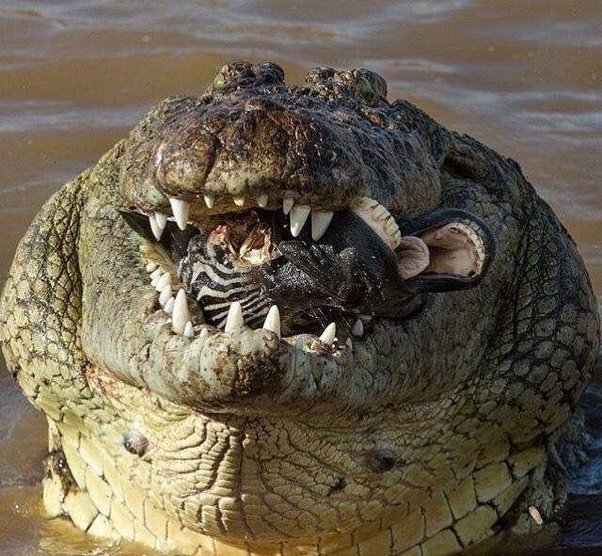
In the still waters of a murky river, silence reigns. The sun beats down on the muddy banks, where nothing seems to move — except for a single dark shape that floats like a piece of driftwood. But that’s no log. It’s a crocodile — nature’s perfect predator, perfected over millions of years of evolution.
Its eyes barely break the surface, cold and unblinking. Beneath the calm exterior lies a body built for ambush and destruction. The crocodile’s armor — thick, ridged, and nearly bulletproof — glistens under the light. It’s a fortress of bone and muscle, protecting a creature that has survived when so many others have gone extinct.
For hours, it waits. Crocodiles are patient hunters. They don’t need to chase. They don’t need to roar. They simply wait for the perfect moment. And then — with terrifying speed — they strike.
A small antelope bends down to drink from the water’s edge. The surface ripples ever so slightly, a whisper of danger that goes unnoticed. In less than a second, the calm turns to chaos. The “log” explodes from the river — a flash of scales, teeth, and raw power. The crocodile’s jaws clamp down with crushing force, stronger than any other animal on land. Once it grips, there’s no escape. The prey struggles, thrashes, but the predator’s hold is absolute.
Then comes the infamous death roll — a brutal twist of muscle that tears, breaks, and subdues. The river turns red, then still again. Nature returns to silence.
For an animal that can grow over sixteen feet long and weigh more than a thousand pounds, the crocodile moves with shocking speed — a blend of ancient design and lethal precision. It doesn’t need evolution anymore; it is evolution’s masterpiece.
As the sun sets, the great reptile sinks back beneath the surface, vanishing into the depths like a ghost. The jungle hums, unaware that beneath those quiet waters waits the perfect hunter — unchanged, unmatched, and utterly unstoppable.


0 Comments