
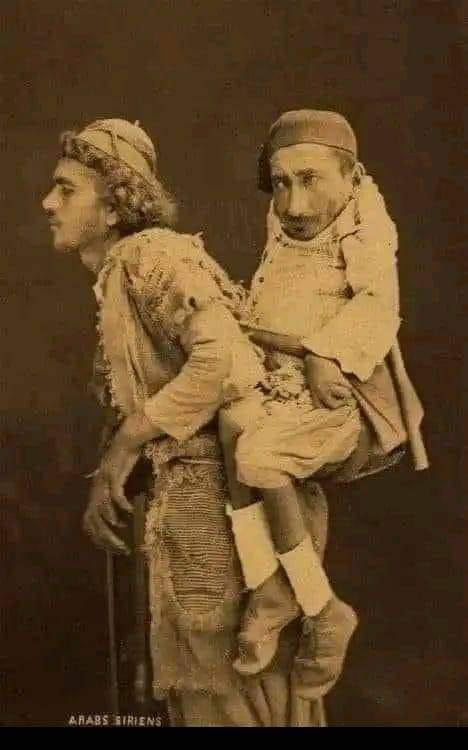
In the year 1899, the bustling old streets of Damascus echoed with the sounds of merchants, storytellers, and distant prayers. Among the many faces in the city were two boys who stood out—not because of their disabilities, but because of the extraordinary bond they shared.
One of them was Samir, a young Christian boy who had lost the use of his legs. The other was Muhammad, a Muslim boy who had been blind since birth. Both were orphans, alone in the world except for each other. They lived together in a small, modest room not far from a popular café in the city.
Despite their hardships, the two had created their own perfect balance:
Samir could not walk, and Muhammad could not see.
So Muhammad became Samir’s legs, and Samir became Muhammad’s eyes.
Every morning, Muhammad would crouch down so Samir could climb onto his back. With Samir guiding him through the noisy streets—“Left here, Muhammad… slow down… now straight”—they moved as one, relying on each other completely. To the people of Damascus, the sight of the two boys passing by had become familiar, almost comforting.
Samir worked as a hakawati, a traditional storyteller. At the café, he sat on a cushion, holding the attention of customers with tales from One Thousand and One Nights, weaving stories of kings, jinn, desert adventures, and enchanted cities. His voice was warm and vibrant, and even the busiest merchants would pause to listen.
Just outside the café stood Muhammad, selling sweets—small, simple treats—but he always kept one ear turned toward his friend’s voice. Though he could not see the audience, he could picture the magic in their silence, in their laughter, and in the way Samir’s words filled the air. Listening to those stories was his greatest joy.
Together, the two boys survived not through charity, but through the work of their own hands and the strength of their friendship.
One evening, Muhammad returned to their small room carrying the coins he had earned. As usual, he called out Samir’s name, expecting to hear his soft reply. But the room was silent.
When he reached Samir’s bed, he realized that his friend—his eyes, his companion, his brother—had passed away quietly during the day.
Muhammad cried until his tears dried, and still he cried more. For seven days, neighbors heard his grief. People came to comfort him, but words meant little. He had lost the one person who made his world visible.
Someone finally asked him, gently:
“Muhammad, how did you and Samir live together so well, even though you came from different religions?”
Muhammad placed his hand on his chest and said simply:
“Here… here we were the same.”
In a city rich with history, cultures, and faiths, their friendship became a quiet legend—an example of love without conditions, and unity without boundaries.


0 Comments