
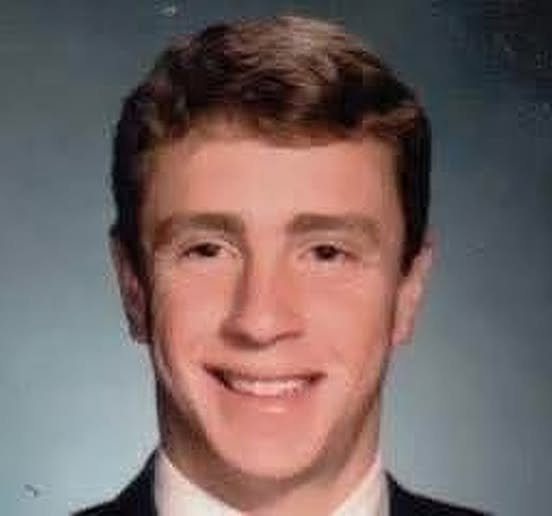
On the morning of September 11, 2001, 24-year-old Welles Remy Crowther went to work as usual. He was an equities trader at Sandler O’Neill and Partners, working on the 104th floor of the South Tower of the World Trade Center.
At 9:03 a.m., United Airlines Flight 175 struck the South Tower between the 77th and 85th floors — just below where Crowther’s office was. Smoke, fire, and debris filled the air instantly.
Minutes later, Crowther managed to call his mother and left a short, calm message:
“Mom, this is Welles. I want you to know that I’m okay.”
That was the last time anyone heard his voice.
A Red Bandana and a Firefighter’s Spirit
Welles Crowther had always been brave and compassionate. From childhood, he dreamed of becoming a firefighter like his father, Jefferson Crowther. When he was six, his dad gave him a red bandana, which he carried everywhere — in his pocket, at sports games, and even to work.
Before working on Wall Street, Welles had volunteered as a firefighter in his hometown of Nyack, New York. He had been trained to stay calm in emergencies, use rescue tools, and protect others — skills that would prove vital that day.
The 78th-Floor Sky Lobby
After the impact, Crowther found his way down to the 78th-floor sky lobby, a major transfer area for express elevators. The scene was horrific — walls torn apart, flames spreading, people injured and confused.
In that chaos, a tall man wearing a red bandana appeared. He took charge. Covering his nose and mouth against the smoke, he directed survivors toward the only passable stairway.
He told them firmly,
“Everyone who can stand, stand now.
If you can help others, do so.”
He carried an injured woman on his back down 15 floors to safety. Then, instead of escaping, he went back up — again and again — to rescue more people.
A Selfless Hero
Survivors later described the same man: calm, confident, covered in dust, but always wearing a red bandana. He organized small groups, comforted the injured, and kept returning to help others find the way down.
One survivor, Ling Young, said:
“He is absolutely my guardian angel — no question — because without him, we would have been waiting when the building collapsed.”
Another survivor, Judy Wein, also remembered his reassuring voice and the red bandana that became a symbol of courage.
His Final Moments
When the South Tower collapsed at 9:59 a.m., Welles Crowther was still inside, helping others. Months later, his body was found alongside several New York City firefighters in a stairwell — heading back up, carrying rescue equipment known as the “jaws of life.”
He had become, in every sense, the firefighter he had always wanted to be.
Legacy of the Man in the Red Bandana
After survivors told their stories, Crowther’s parents realized that the man in the red bandana everyone described was their son.
Welles Crowther is credited with saving at least 12 lives that day.
His courage and selflessness have been honored across the U.S.:
- The President of the United States recognized him posthumously for heroism.
- The Red Bandana Project was created to teach young people about leadership and compassion.
- Boston College, his alma mater, holds an annual “Red Bandana Game” in his memory.
- A documentary titled “The Man in the Red Bandana” was also made about his story.
A Symbol of Hope
Welles Crowther’s red bandana became a symbol of bravery, sacrifice, and humanity.
In one of the darkest moments in American history, he showed the world what it means to live — and die — for others.
As his mother, Allison Crowther, once said:
“He carried that red bandana for years, and it carried him through the last hour of his life.”


0 Comments