
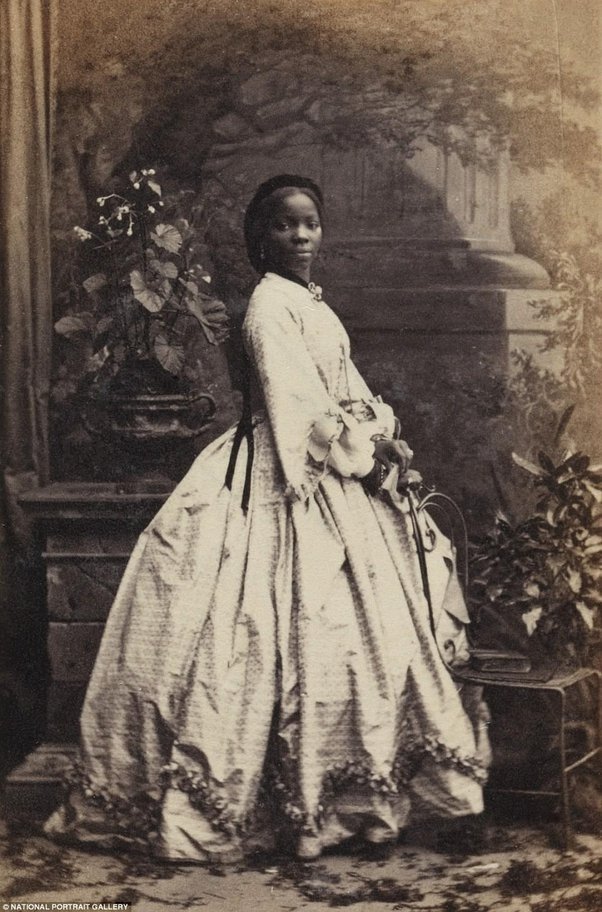
Sarah Forbes Bonetta — originally named Aina — was born around 1843 in what is now southwest Nigeria, into the Egbado (Yewa) people. Her early childhood was peaceful, but everything changed when she was about eight years old.
Captured During a Slave Raid
In 1848, the powerful Kingdom of Dahomey carried out a violent raid on her village.
During this attack:
- Her parents and many of her community members were killed.
- Aina was taken prisoner and brought to the court of the King of Dahomey, Ghezo.
She was kept there for about two years. It was common for captives to be used as slaves or sacrificed during ceremonies, so her life was at great risk.
Meeting Captain Frederick E. Forbes
In 1850, a British naval officer, Captain Frederick E. Forbes, visited Dahomey on behalf of Britain. When the King of Dahomey learned that Forbes was visiting on behalf of Queen Victoria, he decided to give Aina to him as a “gift” for the Queen — a gesture meant to show respect and alliance.
Captain Forbes accepted the girl in order to save her life.
A New Name and a New Life
Captain Forbes renamed her Sarah Forbes Bonetta:
- Sarah – a common English name
- Forbes – his own surname
- Bonetta – the name of his ship
He brought her to England, where she was presented to Queen Victoria.
Queen Victoria’s Interest in Sarah
Queen Victoria was impressed by Sarah’s intelligence, manners, and potential. She quickly became fond of the young girl and decided to support her future.
The Queen arranged for:
- Sarah to be raised in a caring, well-off English household
- A proper education
- Supervision and protection throughout her childhood
Sarah proved to be exceptionally intelligent. Many people who met her described her as having “extraordinary” or “genius-level” ability, especially in languages, academics, and music.
Growing Up in Victorian England
Sarah became well-known in English society, often visiting the royal family and attending important gatherings. Despite the challenges of being a young African girl in Victorian England, she carried herself with grace and confidence.
However, her life wasn’t always easy. She struggled at times with sickness, the pressures of society, and the expectations placed on her by the public and the monarchy.
Marriage and Adulthood
In 1862, at the age of 19, Sarah married James Pinson Labulo Davies, a wealthy Yoruba merchant and philanthropist based in Sierra Leone. Although the marriage was encouraged by Queen Victoria, James Davies treated Sarah with respect and provided her with a stable life.
After their marriage, the couple moved between Sierra Leone and England.
Motherhood
Sarah and James had three children. Their eldest daughter was named Victoria Davies, after Queen Victoria. The Queen was so fond of Sarah that she agreed to be baby Victoria’s godmother.
This strengthened the bond between the families and showed how deeply Queen Victoria cared for Sarah.
Illness and Early Death
Sadly, Sarah’s health began to decline in her twenties. She developed tuberculosis, a common but deadly disease at the time.
At the Queen’s arrangement, she traveled to Madeira, a Portuguese island, hoping the warm climate would help her recover.
But her condition worsened.
Sarah Forbes Bonetta died on August 15, 1880, at about 37 years old.
Her Legacy
Sarah’s story is remarkable because:
- She survived slavery and violence.
- She became a member of Victorian high society.
- She formed a personal bond with one of the most powerful monarchs in history.
- Her descendants continued to be part of influential African communities.
Today, Sarah Forbes Bonetta is remembered as:
- A symbol of resilience
- A brilliant woman who overcame unimaginable challenges
- A historical figure who bridged African and British cultures


0 Comments