
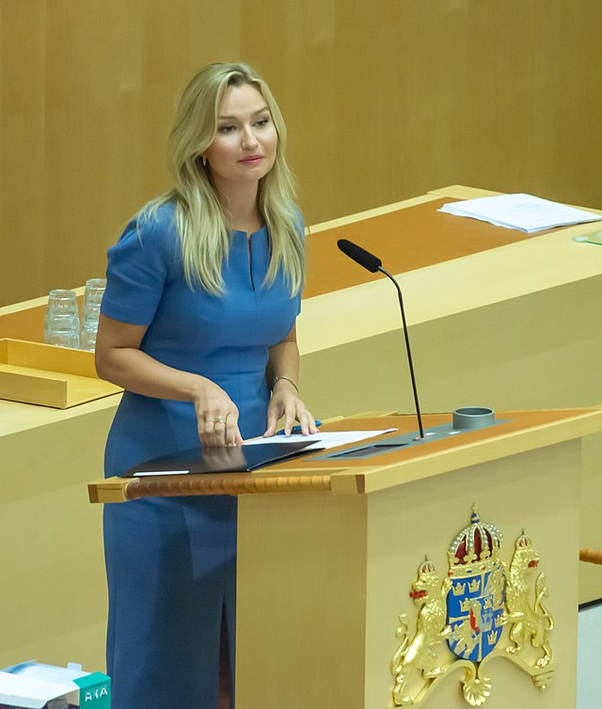
Sweden’s Deputy Prime Minister Ebba Busch has ignited intense national debate after making a series of forceful statements urging Muslim immigrants to adapt to Swedish values and warning that certain religious practices have no place in the country. Her comments, delivered in political speeches and recent public interviews, have drawn both fierce criticism and strong support across Sweden’s political landscape.
Busch, who also serves as Minister for Energy, Business, and Industry and leads the Christian Democrats (KD), argued that while Muslims are welcome in Sweden, Islam as practiced in some countries is incompatible with Swedish democratic norms. She emphasized that Sweden must remain firm in defending its core values, which she described as rooted in Christian ethics, Western humanism, gender equality, and individual freedom.
According to reporting in Swedish and international media, Busch stated that “Islam must adapt to Swedish values,” adding that individuals who refuse to integrate “should leave the country.” She also condemned practices such as honor killings, stoning of women, beheadings, and the implementation of Sharia law, declaring that they “have no place in Sweden.” Supporters of Busch interpret these comments as a necessary stand against extremism, particularly in light of recent incidents related to honor-based violence and growing concerns about parallel societies.
In addition to her remarks on integration, Busch has recently called for a nationwide ban on the public wearing of burqas and niqabs. She argues that full-face coverings are symbols of what she calls “strict or totalitarian interpretations of Islam” and therefore conflict with Sweden’s commitment to gender equality and open society. The proposed ban would apply to public spaces such as streets, shops, and healthcare centers, though not inside private homes.
Busch insists that her aim is not to target Muslims as a whole but to confront oppressive practices. She claims that Sweden’s long-standing tolerance has at times been “naive,” allowing environments where radical interpretations of religion can flourish. “You can be a proud Swedish Muslim,” she has stated, “but there are fundamental Swedish values that must apply to all who live here.”
The backlash, however, has been swift. Opposition parties, Muslim organizations, and civil-rights advocates accuse Busch of stigmatizing Sweden’s Muslim population—one of the largest in Western Europe—and of fueling polarization. Critics argue that her statements risk blurring the lines between targeting extremist behavior and casting suspicion on millions of peaceful, law-abiding Swedish Muslims. Some legal scholars have also questioned whether a burqa/niqab ban would comply with freedom-of-religion protections under Swedish and EU law.
Despite the controversy, Busch’s comments have resonated with Swedes concerned about integration, public safety, and cultural cohesion. Polls in recent years show increasing public support for stricter immigration and integration measures. As the debate intensifies, Busch’s remarks have positioned her at the center of Sweden’s ongoing struggle to balance pluralism with preserving national values.
The discussion is expected to continue in the coming months, especially as the government evaluates proposals for face-covering bans and integration reforms. Whether Busch’s rhetoric will lead to concrete policy changes—or deepen existing divisions—remains a central question in Sweden’s political landscape.


0 Comments