
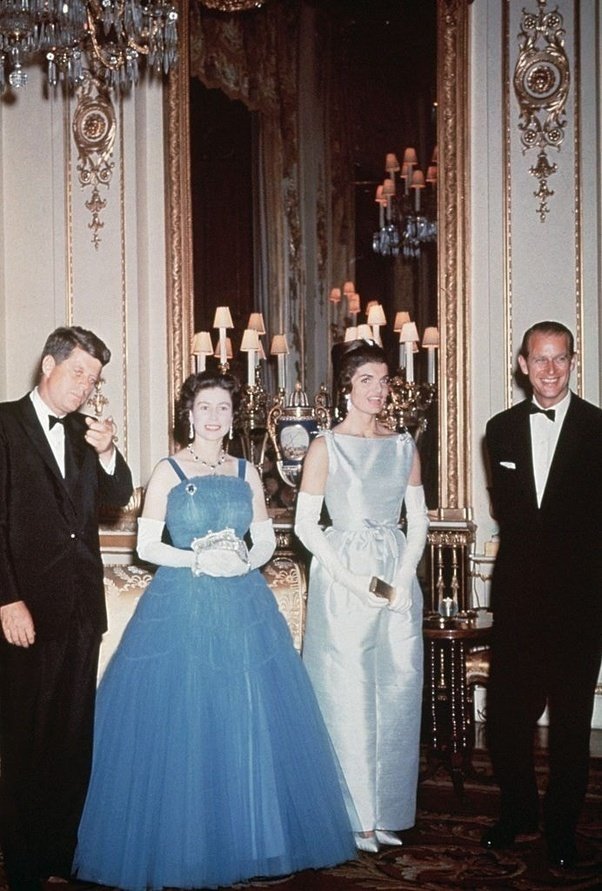
On June 5, 1961, Queen Elizabeth II welcomed President John F. Kennedy and First Lady Jacqueline Kennedy to Buckingham Palace for a formal dinner. At first glance, this seemed like just another state occasion — after all, the Queen had met countless world leaders before. But behind the palace doors, there was an undeniable tension between the two most famous women in the world at that time.
A Year of Exhaustion for the Queen
For Queen Elizabeth, 1961 had already been an incredibly busy and tiring year. She had just turned 35 years old, was the mother of three young children, and had spent much of the previous months on a series of demanding royal tours. In a single year, she visited Canada, Cyprus, India, Pakistan, Nepal, Iran, Ghana, and the United States, representing Britain across the globe.
By the time the Kennedys’ visit was arranged, the Queen was weary — and, according to reports, not particularly excited about another high-profile event. But what made the situation more delicate was the strained relationship between her and Jackie Kennedy.
Jackie’s Unkind Comments
Jackie Kennedy, known worldwide for her style, grace, and intelligence, was considered the epitome of modern elegance. Before her visit, however, she had allegedly made some critical remarks about the Queen.
She reportedly described Buckingham Palace as “second-rate and gloomy” and commented that the Queen’s fashion sense was “rather old-fashioned.” These remarks reached Elizabeth’s ears — and they hurt. The Queen, though always composed in public, was said to have been personally offended by the young First Lady’s comments.
Two Very Different Women
Part of the tension stemmed from how different the two women were.
- Queen Elizabeth II had been raised with a deep sense of duty, tradition, and protocol. Her life was shaped by centuries of monarchy and strict royal customs.
- Jackie Kennedy, though not of noble birth, came from America’s social elite and was admired as a modern aristocrat — glamorous, cultured, and effortlessly stylish.
Their meeting was therefore not just a political event — it was almost symbolic, a quiet contest between royalty and celebrity, tradition and modernity, duty and charm.
The Queen’s Strategy: Be Royal, Not Fashionable
As the event approached, the British press was in a frenzy. The Kennedys were global celebrities, and the entire world seemed more interested in Jackie than in anyone else. Queen Elizabeth knew she could not compete with the First Lady’s fashion or youthful glamour — so she chose to focus on what no one else could replicate: her royal dignity.
She turned to her trusted designer, Sir Norman Hartnell, the man who had created her wedding dress and coronation gown. Together, they designed a special gown for this occasion — one that would later become famous as “The Cobalt Dress.”
The gown was made of layers of Royal Blue tulle, soft yet commanding. It was elegant, classic, and regal — exactly what a queen should wear. She completed the look with white satin gloves, her Order of the Garter sash, and exquisite diamond and sapphire jewelry.
The Night at Buckingham Palace
When the evening finally arrived, the palace glittered with formality and anticipation. The dinner was attended by royalty, statesmen, and diplomats, but the focus was on the Queen and the First Lady.
Witnesses described the atmosphere as polite but slightly chilly. The Queen and Jackie exchanged formalities, but there was little warmth between them. Some accounts suggest that Jackie later admitted she felt “a little nervous” in the Queen’s presence — perhaps realizing the immense weight of tradition that surrounded Elizabeth.
In the end, however, the Queen’s strategy worked. While Jackie was admired for her beauty and poise, it was the Queen who commanded true presence. Her Cobalt Dress, her calm demeanor, and her unmistakable royal grace reminded everyone who the real monarch was.
Aftermath and Mutual Respect
Despite the early friction, later meetings between the two women were reportedly much friendlier. When President Kennedy was tragically assassinated in 1963, Queen Elizabeth sent her deepest condolences and even dedicated a memorial to him in Runnymede, England, where the Magna Carta had been signed.
In the years that followed, both women came to be seen as icons of their own worlds — the Queen representing steadfast duty and tradition, Jackie symbolizing modern elegance and resilience.
Legacy of “The Cobalt Dress”
The gown Queen Elizabeth wore that evening — the Cobalt Dress — remains one of her most celebrated looks. It was more than just fashion; it was a statement of identity.
Faced with the glamour of Jackie Kennedy, Queen Elizabeth proved that royalty does not need to compete — it simply reigns.


0 Comments