
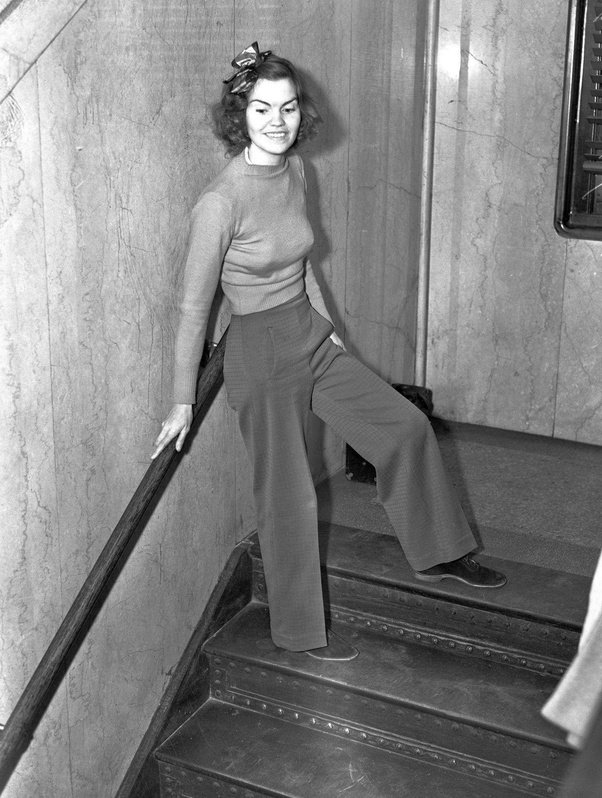
Woman Jailed for Wearing Pants in Court Wins Appeal, Securing Right for Others
LOS ANGELES, November 1938 – A 29-year-old kindergarten teacher from Los Angeles made national headlines this month after being sentenced to five days in jail for the simple act of wearing slacks to court. Helen Hulick’s defiance of a judge’s dress code order not only landed her behind bars but ultimately overturned a longstanding courtroom tradition, granting women the legal right to wear trousers in federal and state proceedings.
The Incident: November 9, 1938
Helen Hulick arrived at the Los Angeles County Courthouse on November 9 to testify as a key witness in a burglary case. She had agreed to speak against two men accused of breaking into her home and attempting to steal valuables. Dressed in a tailored pantsuit—a practical choice for the cool autumn day—Hulick took her place in the witness box.
Presiding Judge Arthur S. Guerin immediately halted proceedings. According to court transcripts and contemporaneous reports in the Los Angeles Times, the judge declared Hulick’s attire “improper” and a distraction to the trial. He ordered the case postponed for five days and instructed the teacher to return in “clothes proper for a lady in court”—explicitly meaning a dress or skirt.
Hulick, unflinching, responded through the press:
“Tell the judge I’m standing up for my rights. If he tells me to wear a dress, I won’t. I like wearing pants. They’re comfortable.”
Her quote appeared in the Los Angeles Times the following day, sparking immediate public debate about women’s fashion freedoms and courtroom decorum.
Second Appearance: Defiance in Slacks
Five days later, on November 14, Hulick returned to court—again wearing pants. This time, a navy blue slack suit with a matching jacket. The courtroom buzzed as spectators craned to see the teacher’s bold ensemble.
Judge Guerin, visibly incensed, addressed her directly from the bench:
“Last time she was in court, dressed like this and with her head tilted back, people paid more attention to her than to the trial—including the prisoners and the court. She was told to wear clothes proper for court. Today she came back in pants again, clearly refusing to follow the court’s order… Get ready to be punished for not obeying.”
The judge cited contempt of court and sentenced Hulick to five days in the county jail. Bailiffs escorted her from the courtroom as reporters scrambled for statements. Hulick maintained her composure, telling journalists outside: “You fight for what you believe in.”
Jail and Public Outcry
Hulick was booked into the Los Angeles County Jail on November 15, where she served her full sentence under standard conditions for contempt charges. Fellow inmates and guards reportedly treated her with curiosity and respect; one jail matron was quoted anonymously saying, “She’s the nicest ‘criminal’ we’ve had in months.”
The story exploded across American newspapers. The New York Times ran a front-page feature titled “Teacher Jailed for Trousers,” while women’s magazines like Ladies’ Home Journal praised Hulick’s stand as a blow against outdated gender norms. Fashion columns noted that slacks had gained popularity among working women during the Great Depression for their practicality, yet remained taboo in formal settings.
The Appeal and Victory
Hulick’s attorney, prominent civil rights lawyer William J. Locke, filed an immediate appeal to the California District Court of Appeal. The case argued that Judge Guerin’s order violated Hulick’s constitutional rights and constituted an abuse of judicial discretion.
On November 28, 1938—just days after Hulick’s release—the appellate court ruled unanimously in her favor. The three-judge panel stated:
“The court finds no statute, precedent, or rule requiring female witnesses to appear in skirts or dresses. The respondent’s attire, while unconventional, posed no material disruption to proceedings. The contempt citation is hereby vacated, and the lower court’s dress mandate overturned.”
The decision set a binding precedent: women could no longer be barred from testifying—or appearing in court—solely for wearing pants. Legal scholars hailed it as a landmark in gender equality under the law.
Aftermath and Legacy
Upon her release, Hulick returned to teaching kindergarten at a local public school, where students reportedly greeted her with drawings of “Miss Hulick in her brave pants.” She declined most interview requests but issued a brief statement:
“This wasn’t about fashion. It was about being treated as an equal citizen.”
Judge Guerin faced no formal reprimand but reportedly ceased enforcing dress codes against women for the remainder of his tenure. The case is now cited in law textbooks as In re Hulick and credited with accelerating the acceptance of pantsuits in professional settings.
Helen Hulick’s five-day jail stint—born of a simple pair of slacks—helped pave the way for generations of women to appear in court on their own terms.


0 Comments