
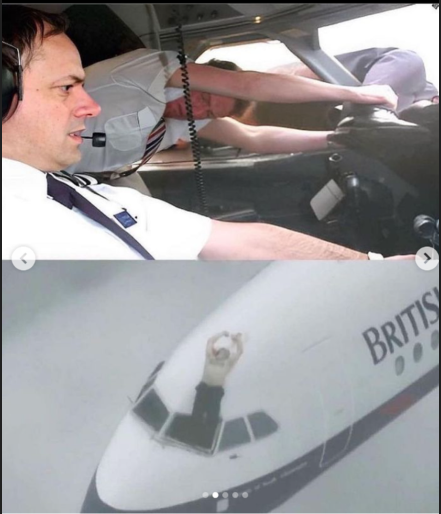
On June 10, 1990, British Airways Flight 5390, a BAC One-Eleven aircraft, was flying from Birmingham, England, to Málaga, Spain. The flight seemed routine, but what happened next would become one of aviation’s most remarkable survival stories.
The Catastrophe in the Sky
At 17,000 feet, something terrifying occurred: the cockpit windscreen panel suddenly blew out. The cause was later found to be improperly fitted bolts during maintenance. The sudden depressurization sent a violent shock through the aircraft.
The cockpit was instantly compromised, and the captain, Tim Lancaster, was sucked halfway out of the aircraft. Only his legs remained inside the cockpit as the wind hurled him against the fuselage. The cold air at altitude and the speed of the aircraft caused severe frostbite, and the force of the wind repeatedly slammed his head and body against the plane.
The Heroic Flight Attendant
Just at that moment, Nigel Ogden, a flight attendant, happened to be entering the cockpit. Seeing the captain being sucked out of the window, Ogden grabbed onto him immediately.
Despite the chaos, Ogden held the captain in place for over 20 minutes, preventing him from being fully ejected. Many of the crew initially believed the captain was already dead, but Ogden refused to let go. His actions were critical, not just for the captain’s survival but also to prevent the captain’s body from colliding with the plane’s engines, wings, or stabilizers, which could have caused catastrophic damage to the aircraft.
The Struggle for Survival
During this harrowing ordeal:
- The captain’s head was repeatedly slamming against the fuselage.
- Both men were exposed to sub-zero temperatures at high altitude.
- Ogden suffered frostbite on his face, dislocated a shoulder, and even damaged one of his eyes from the relentless wind and debris.
Meanwhile, the copilot, Alastair Atchison, had to take control of the aircraft under extreme conditions, performing an emergency descent and landing at Southampton Airport. The situation demanded extraordinary skill and composure, as the plane’s aerodynamics were severely affected by the missing windscreen.
The Miracle of Survival
After a tense 20 minutes in the sky, the aircraft landed safely, and both men were rushed to the hospital.
- Captain Tim Lancaster survived, suffering frostbite and multiple fractures in his arms and hands.
- Nigel Ogden recovered from his injuries, though he had suffered serious frostbite and a damaged eye.
The incident is often cited as an amazing example of human courage and resilience, showcasing how quick thinking, bravery, and determination can avert tragedy in the most extreme circumstances.
Aftermath
The accident led to:
- A full investigation that revealed faulty maintenance procedures.
- Improvements in cockpit windscreen design and installation checks.
- Recognition of Nigel Ogden’s heroic actions, which likely saved the captain’s life.
This event remains one of the most dramatic and inspiring survival stories in aviation history, often featured in documentaries about near-impossible rescues. It’s a story not just of skill and luck but of heroism under unimaginable pressure.


0 Comments