
In 1909, a Danish explorer named Ejnar Mikkelsen embarked on a perilous mission to Greenland, which would eventually lead to an extraordinary tale of survival, endurance, and unexpected companionship. The mission itself was part of a larger effort to gather evidence regarding the disputed geographical claims surrounding Peary Sound in Greenland, an area the United States claimed as a waterway, while Denmark wanted to prove that Greenland was one single, continuous landmass. To achieve this, Mikkelsen and his team were tasked with retrieving a lost map and diary from a previous expedition that had failed to establish the true nature of the land.
The Expedition Begins
Mikkelsen’s expedition, which began in the early 1900s, was meant to be a major undertaking. However, it was marred by a series of setbacks right from the start. The journey was difficult and slow, as Mikkelsen’s team struggled with extreme Arctic conditions and various delays. Eventually, his team faced a grave situation: the other members of the expedition left Mikkelsen and his colleague, Iver Iversen, behind.
Stranded in the Arctic
The two men were abandoned in the frigid, desolate wilderness of Greenland in 1909, at a remote location far from any chance of rescue. They had only a small cabin as shelter. To make matters worse, they were isolated in a hostile environment, surrounded by ice and snow, with little food and no way to call for help.
As the weeks and months passed, their situation grew increasingly dire. Their food supplies were exhausted, and the unforgiving Arctic winter was taking its toll on them. Faced with the harsh reality of survival, Mikkelsen and Iversen were left with no choice but to turn to extreme measures. They were forced to eat their sled dogs to survive. This gruesome decision was a testament to the desperation of their situation. The Arctic landscape offered no other resources, and they were left with no option but to rely on whatever they could find, including the dogs that had once been part of their expedition team.
Psychological and Physical Strain
In addition to the physical hardships, the mental toll of the isolation was immense. Starved and freezing, the men started experiencing the kind of psychological strain that comes from prolonged exposure to extreme conditions. The pair began to suffer from hallucinations, often imagining seeing animals or other figures in the bleak landscape. At one point, they even started to argue over seemingly trivial matters, including a picture of 53 students from a home economics school that hung on the wall of their cabin.
This image became a focal point of conversation for the two men. They spoke of the students in the photo so often that they began to assign personalities to the individuals in the picture, and the topic of these students even sparked heated debates between them. In a strange twist, these imagined conversations and arguments over the photo became a lifeline for their sanity in the face of extreme isolation.
A Shocking Discovery
During their time stranded, Mikkelsen and Iversen learned the full extent of their predicament: there was no one coming to rescue them. The weather was too severe, and any rescue operation would be far too risky. With no hope of immediate help, the two men had to rely on each other for companionship and survival, all while struggling to maintain their mental stability.
But as time went on, it seemed that fate might have other plans for the two explorers. After two and a half years, during which they faced unimaginable hardships, Ejnar Mikkelsen and Iver Iversen were finally rescued. In 1912, a rescue party, having heard of their disappearance, found the two men and brought them back to safety.
The Rescue and the Famous Photo
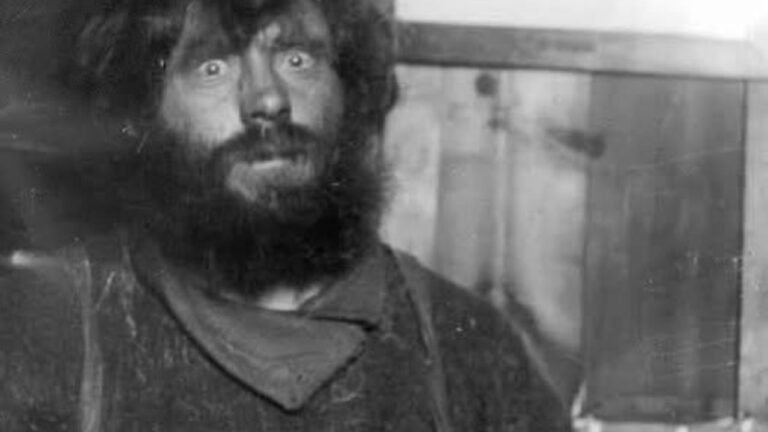
The moment of Mikkelsen’s rescue became iconic. A photograph taken of him after his rescue shows the emaciated explorer standing beside the wall of a small cabin. In the background, there is a photograph of 53 students from a home economics school. This image is notable because it had become so significant to Mikkelsen and Iversen during their two years of isolation. The pair had spent countless hours discussing the students in the photo and fantasizing about their lives, using it as a way to stave off the crushing isolation.
Interestingly, Mikkelsen and Iversen’s ordeal became a source of both fascination and inspiration. The story of their survival, their mental struggles, and the peculiar details—such as the argument over the students in the picture—captured the imagination of people around the world. It became a testament to human endurance, the power of the human mind to cope with extreme conditions, and the unexpected things that can provide comfort and distraction when faced with insurmountable odds.
The Aftermath
After being rescued, Mikkelsen returned to Denmark as a hero, though he was physically weak and mentally scarred by his ordeal. His survival story raised questions about the nature of human endurance in the face of extreme isolation, and it served as an enduring symbol of the struggle for knowledge and exploration in the Arctic regions.
However, despite all the suffering and loss, Mikkelsen’s mission had a silver lining. His discovery of the lost map and diary, though not fully successful in proving his theory about Peary Sound, helped contribute to later expeditions and a deeper understanding of Greenland’s geography.
In the end, the story of Ejnar Mikkelsen and Iver Iversen was not just about survival, but also about the human ability to find meaning and connection—even in the most unlikely and extraordinary circumstances. The bizarre debates over the students’ photograph illustrated just how crucial mental resilience and the need for human connection are in times of extreme hardship.
Legacy
Today, Mikkelsen’s story lives on as one of the most compelling tales of survival in the Arctic. His journey not only helped to advance knowledge of Greenland’s geography but also highlighted the unexpected ways people can find solace in dire circumstances.


0 Comments