
In the aftermath of World War II, Southeast Asia was in chaos. Japan’s surrender in August 1945 had left a power vacuum across Indochina. In Laos, nationalist forces under the Lao Issara (“Free Laos”) movement — supported by Vietnamese revolutionaries of the Viet Minh — declared independence and took control of many towns, including Thakhek, a river city on the Mekong in central Laos.
Thakhek was not only strategically important but also home to a large Vietnamese community. During the war, thousands of Vietnamese workers and their families had settled there, helping build infrastructure for the French. When France lost control during the Japanese coup of March 1945, many of these Vietnamese joined or sympathized with the Lao Issara movement.
By early 1946, France was determined to reclaim its colonies. French troops, reorganized under General Leclerc, began pushing back into Laos from Vietnam. Their orders were clear — retake major towns and destroy resistance. One of their main targets was Thakhek.
The Battle and the Massacre
On March 21, 1946, French forces launched a major assault on Thakhek. The town was defended by Lao Issara fighters and Vietnamese volunteers loyal to Prince Souphanouvong, who would later become the first President of communist Laos.
The fighting was fierce. French troops used heavy artillery, mortars, and even aircraft to bombard the city. The defenders fought bravely but were outgunned and outnumbered. Within hours, Thakhek was burning.
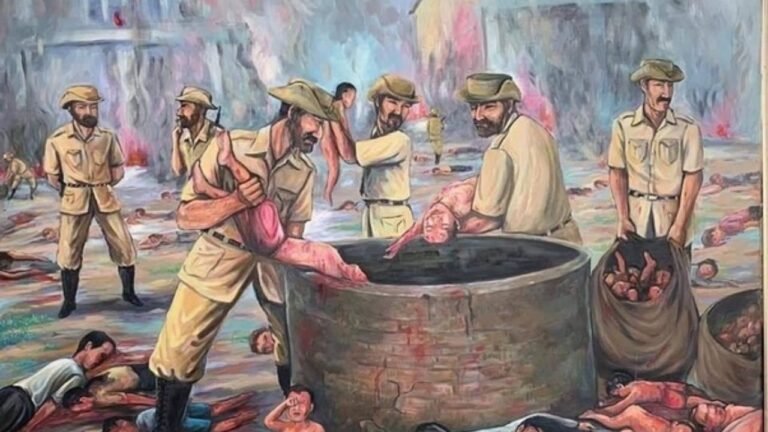
When French forces finally entered the city, the battle turned into a massacre.
According to Laotian and Vietnamese reports, the French soldiers — enraged by the resistance and losses — killed thousands of civilians, most of them Vietnamese men, women, and children. Houses were looted and burned. Many residents were shot on sight. Witnesses later claimed that bodies were thrown into wells and into the Mekong River to hide the evidence. Entire Vietnamese neighborhoods were wiped out.
Lao sources say between 1,500 and 3,000 people were killed that day.
Western accounts, like later U.S. and French reports, gave lower figures — around 700 defenders and 300 civilians — but did not deny that many non-combatants died.
Whatever the exact number, Thakhek was devastated. Survivors fled across the Mekong into Thailand, and thousands of Vietnamese refugees began a long exile that would last for years.
Aftermath
The massacre at Thakhek became one of the darkest moments of France’s reconquest of Indochina. News of the killings spread quickly, fueling anti-French anger across Laos and Vietnam. It deepened the divide between the colonial authorities and the local populations, and strengthened support for the Lao Issara and the Viet Minh.
Prince Souphanouvong later described the event as “the day Thakhek was drowned in blood.”
For the French, the operation was described simply as a “military victory.” But for Laos and Vietnam, it was remembered as a crime against humanity — a brutal reminder of colonial repression.
Legacy
Today, March 21 is commemorated every year in Khammouane Province, Laos, as a day of mourning. Ceremonies are held at memorials honoring the victims — Lao and Vietnamese alike — who died in the fighting and the massacre.
The Thakhek Massacre stands as a symbol of the violent birth of modern Laos — a tragedy born from the clash between colonial power and the struggle for independence.


0 Comments