
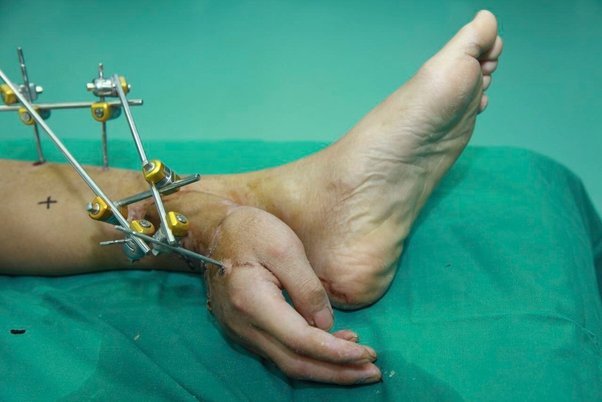
On December 4, 2013, in Changsha, Hunan Province, China, a factory worker named Mr. Xiao Wei suffered a horrific workplace accident. While operating a rotary blade machine, his right hand was completely severed from his arm.
When he was rushed to the hospital, doctors quickly realized that the damage was too extensive to immediately reattach the hand. The muscles, tendons, and nerves in his forearm had been badly crushed. Simply sewing the hand back on at that moment would have led to tissue death (necrosis) because the blood vessels couldn’t yet supply it properly.
But the medical team at Xiangya Hospital, led by Dr. Tang Juyu, came up with an extraordinary plan. To keep the hand alive while waiting for the arm to recover, they decided to temporarily attach the hand to his left ankle.
Why They Attached It to His Ankle
The idea was to use the blood vessels in the ankle to provide temporary circulation to the severed hand. By connecting the hand’s arteries and veins to those in the ankle, they ensured that the hand’s tissues continued to receive oxygen and nutrients, preventing them from dying.
This kind of procedure is rare but not unheard of—it’s a remarkable example of microsurgery, where surgeons work with blood vessels and nerves thinner than a millimeter.
Dr. Tang explained that if the hand hadn’t received blood flow for more than 10 hours, it would have been impossible to save. So, they acted quickly, attaching it to the ankle as a living “storage” site.
The Second Surgery — Reattaching the Hand
After a month of recovery, once the damaged tissues in the arm had healed enough to restore circulation, doctors performed a second surgery to reattach the hand to its original position.
The complex operation involved reconnecting bones, tendons, arteries, veins, and nerves. Over time, Mr. Xiao underwent physical therapy to regain movement and sensation.
Outcome
Doctors later reported that Mr. Xiao’s hand had partially regained function and feeling, and he was able to move his fingers—a miracle considering the extent of his injury.
This case has since become a landmark example of innovation in reconstructive microsurgery.
The Significance
This extraordinary case demonstrates:
- The power of medical knowledge and innovation
- How quick thinking and surgical expertise can save a limb once thought impossible to restore
- The remarkable resilience of the human body
It’s both scientifically fascinating and deeply inspiring—a symbol of how far medicine has advanced.


0 Comments